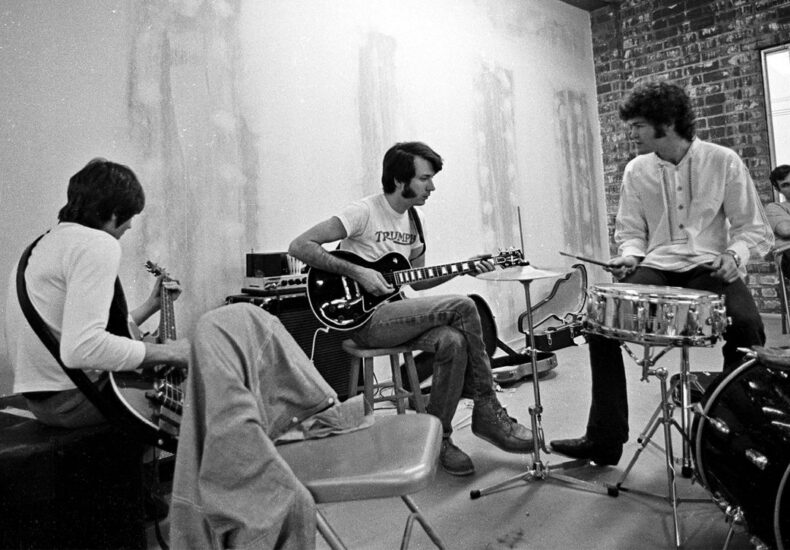
“It started with a suggestion to come up with something Beatle-ish, like‘Ticket to Ride.’” The guitarist behind the 1960s pop hitmakers who sold more records than the Beatles and Rolling Stones combined
From the late 1960s through the 1980s, few session guitarists were as in demand as Louie Shelton. His electric and acoustic guitar work graces hundreds of hit recordings, including Boz Scaggs’ “Lowdown,” Lionel Richie’s “Hello,” Neil Diamond’s “Play Me,” and the Jackson Five’s “I Want You Back,” “ABC,” and “I’ll Be There.”
As a member of the famed Wrecking Crew group of studio musicians, Shelton performed on sessions for the fictional TV band The Partridge Family. Beyond that, his recordings appear on works by artists like John Lennon, Whitney Houston, Barbra Streisand, Marvin Gaye, Diana Ross, the Carpenters, Joe Cocker, Kenny Rogers, the Mamas & Papas, James Brown, and Ella Fitzgerald, among many others. He also played on and produced Seals & Crofts’ biggest hits, “Summer Breeze,” “Diamond Girl,” and “We May Never Pass This Way Again.”
### Early Career and Breakthrough
Shelton’s rise from obscurity to becoming a studio session ace came about through a stroke of incredible luck. He was first introduced to the Los Angeles studio scene in the early 1960s by his friend and fellow Arkansan, Glen Campbell, who was then a member of the Wrecking Crew. Although Shelton occasionally subbed for Campbell, his only foothold in the tightly knit scene was doing sessions for B-grade publishing demos.
“Glen Campbell’s ex-drummer had joined my band in Santa Fe, New Mexico just before we went out to Los Angeles in 1963,” Shelton tells Guitar Player from his home on the Gold Coast in Australia, where he lives today. “And somehow he got in with the songwriting duo Tommy Boyce and Bobby Hart, doing their demos.” That connection eventually led Shelton to work directly with Boyce and Hart.
By the time he met Boyce and Hart in 1965, they had already written hits for groups like Jay & the Americans (“Come a Little Bit Closer”) and Paul Revere & the Raiders (“(I’m Not Your) Steppin’ Stone”). However, the work wasn’t steady, and Shelton eventually drifted away from L.A.
### The Monkees and the “Last Train to Clarksville” Riff
Shelton was performing with Seals and Crofts at the Stardust in Las Vegas when Boyce and Hart approached him with exciting news: they were pitching songs for a new TV show about a fictional rock group called The Monkees.
“Boyce and Hart came up to me and said, ‘We’d love for you to come back and do it with us,’” Shelton recalls. “So I started going back and forth for a while to do the demos for The Monkees.”
Over the next few weeks, Shelton made recordings with Boyce and Hart as they fought competition to secure the Monkees gig. “It was getting down to the wire as to whether Boyce and Hart were going to be accepted,” Shelton explains. “Other people were doing stuff as well.”
While working on one of Boyce & Hart’s new songs, “Last Train to Clarksville,” Shelton struck musical gold with a guitar riff that would forever change his career trajectory.
“It all started out with a suggestion to come up with something kind of Beatle-ish,” he recalls, “like a ‘Ticket to Ride’ riff, where the guitar starts the whole thing off.”
“They brought in the TV show executives to hear what we had worked up so far. At that point they had the Monkees theme song, but all we had of ‘Last Train to Clarksville’ was my guitar riff. But just hearing that very guitar lick I came up with got them accepted to do The Monkees. ‘Clarksville’ is the one that sent them off and skyrocketed the whole progress of the project.”
Shelton emphasizes the power of that riff: “I guess it just shows you the strength of having a guitar lick like that. You recognize it as soon as it comes on. It hits you. And evidently it grabbed them and won them over, too.”
### Recording the Hit Single
Once the tune was written, they entered RCA Victor’s studio to record it. “I had my 1964 Fender Telecaster and a ’64 Fender Super Reverb that had four 10-inch speakers in it, which I had been using in the clubs,” Shelton reveals. “And as we were recording ‘Clarksville,’ they kept saying, ‘Turn it up! Turn it up!’ They wanted a loud and big, bright sound.”
Released in August 1966 as The Monkees’ debut single, “Last Train to Clarksville” rocketed to number one on the Billboard chart. It was the start of an impressive run that would see The Monkees release four albums over the next 16 months. Aided by the success of their hit TV show, the group sold more records in 1967 than the Beatles and Rolling Stones combined.
### Becoming Boyce & Hart’s Go-To Guitarist
In the wake of the single’s success, Shelton became Boyce & Hart’s full-time go-to guitarist. “I basically played on all the stuff that Boyce and Hart did,” he says. “There were other people who did stuff for The Monkees too, using a different band that included James Burton and Glen Campbell on guitar.”
“But with the Boyce and Hart band, none of us were even near top session players. We were all just starting out as session players ourselves. Yet, it was Boyce and Hart that got the majority of the hits.”
Shelton’s love of all styles of music and guitar players heavily influenced his approach to their music. His versatility shone through especially on “Valleri,” another Boyce and Hart tune for The Monkees, where he added flamenco guitar stylings.
“In my early days, I had records by flamenco player Sabicas, and a lot of those flamenco songs had a certain kind of chord progression to them,” he explains. “So when they started playing ‘Valleri’ with that E minor to D major to C major chord run down, to me it was very flamenco sounding.”
“As a joke, I started playing these fast notes over those chords, like a flamenco thing. It was a direct steal from flamenco. I was just being a smart ass. But they said, ‘Oh, that’s great.’ So I played it.”
Shelton notes, “What’s interesting is that I’ve gotten probably more response over the years from that guitar part than any other solo I ever did because it was such a strange thing to come out on a pop record. Later on, I felt bad about it, because I thought, ‘Well, [Monkees guitarist] Michael Nesmith is going to have to fake these runs.’”
### Working With The Monkees
It’s well documented that all the members of The Monkees were musically adept but were not allowed to play instruments on their earliest recordings or have input into the material Shelton and the other session musicians were recording.
“They were never around to even have an opinion. I hadn’t even met them until after we had done all the recordings,” Shelton says. “We would come in during the daytime and do the tracks while they were filming the TV show. They would only come in later in the evening and do their vocals.”
“But I do know to some degree that it was upsetting for them. And there’s a lot that’s been written about that, but I think they eventually accepted the fact that they wouldn’t have been able to come up with that stuff. They were not at that point, yet.”
The Monkees eventually convinced RCA to let them play their instruments on their mid-1967 album *Headquarters*. Soon afterward, they toured, notably with Jimi Hendrix opening for them.
“When that first record came out and was a hit,” Shelton explains, “we had one little get-together with The Monkees, showing them, ‘Here’s what I played and here’s how I played it, and just get as close to that as you can.’ We had that for just one day, and that was the last time I saw them.”
### Joining The Wrecking Crew
Shelton’s work with The Monkees opened many doors, including entry into The Wrecking Crew. By then, Glen Campbell had become a successful solo artist with hits like “By the Time I Get to Phoenix” and “Wichita Lineman.” Campbell departed the Wrecking Crew near the end of 1967, leaving a spot open for Shelton.
“That was my mission — to break into the big league session career. The Monkees are what opened that door for me,” Shelton says. “Coming into The Wrecking Crew, I was one of the younger members, at a time when some of the older players were dropping off due to age or health, so new players were coming in.”
He reflects on his long journey: “It had been a long road for me from my first group when I arrived in L.A. in ’63 — a folk duo called Joe and Eddie. I did a few albums with them, but there was a lot of time between that gig, The Monkees a couple of years later, and finally becoming part of The Wrecking Crew.”
—
Louie Shelton’s journey from humble beginnings to becoming one of the most sought-after session guitarists in American music history exemplifies talent, versatility, and a bit of fortunate timing. His riffs and rhythms continue to echo through some of the most iconic songs of the past decades.
https://www.guitarplayer.com/guitarists/the-guitarist-behind-the-monkees-breakthrough-hit
You may also like
更多推荐
You may be interested
 The New York Times
- Late Night Tells the Tale of Dueling Senators 2026 年 3 月 19 日 Trish Bendix
- The Iran War’s Economic Threat to Europe and Asia 2026 年 3 月 19 日 Eshe Nelson and River Akira Davis
- Palestinian Man Recounts Brutal Sexual Assault by Israeli Settlers 2026 年 3 月 19 日 David M. Halbfinger and Fatima AbdulKarim
- In Swaths of Germany, the Far-Right AfD Is Part of the Fabric 2026 年 3 月 19 日 Jim Tankersley, Tatiana Firsova and Clay Risen
- Ozempic Is About to Go Generic in India, China and Canada 2026 年 3 月 19 日 Rebecca Robbins, Meaghan Tobin, Eshe Nelson, Alex Travelli and Pragati K.B.
- Joseph Duggar of ’19 Kids and Counting’ Faces Child Sex Abuse Charges 2026 年 3 月 19 日 Hannah Ziegler
- Trump’s Planning for America’s 250th Emphasizes Religion’s Role in the Nation’s Founding 2026 年 3 月 19 日 Jennifer Schuessler and Zachary Small
- U.S. Intelligence Saw No Change in Iran’s Missile Capabilities Before War 2026 年 3 月 19 日 Robert Jimison
- Family of Minneapolis Boy Detained by ICE Faces Fast-Track Deportation 2026 年 3 月 19 日 Miriam Jordan
- Bondi Doesn’t Commit to Deposition With House Panel Over Epstein Files 2026 年 3 月 19 日 Michael Gold
Leave a Reply