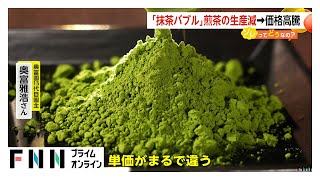
Global Matcha Boom Pushes Sencha Into Crisis
A matcha specialty store in Tokyo’s Asakusa, popular with foreign tourists who now account for about 80 percent of customers, offers rich matcha drinks and desserts such as ice cream and cream puffs. Visitors from the United States praised the taste, calling it delicious and saying, “I love matcha.”
Demand for matcha is rising worldwide, but shop operators say they are considering price hikes as raw material costs climb. According to Sugawara Mirai, manager of Rai Ichi-cha Matcha Experience, inbound demand is high, and that is pushing up the price of matcha. The average cost per kilogram has surged 1.5 times in five years, with Uji tea in Kyoto expected to reach around 14,000 yen per kilogram in 2025—about 2.6 times higher than 2024 levels.
Farmers are responding by shifting from sencha to tencha, the shaded tea leaves used to produce matcha. At Yame Miryokuen Seicha in Fukuoka, president Kazunobu Ejima said that where production once consisted of 70 percent sencha and 30 percent matcha, the ratio has now flipped to 60 percent matcha and 40 percent sencha.
The cultivation of tencha requires covering fields with black sheets for around 20 days before harvest, adding to labor but offering higher returns. This trend, however, is straining sencha supply. Prices for first-flush sencha in Kyoto reached 4,482 yen per kilogram, up more than 1,000 yen from 2024, while second-flush leaves, used in bottled drinks, rose over 60 percent.
Consumers in the streets voiced concern: “Sencha is the taste we are used to. It’s important for Japanese people, from the elderly to children. If prices go up, it will be a problem.”
Some growers remain cautious. In Saitama, where the Sayama tea brand is cultivated, farmer Masahiro Okutomi of Okutomi-en noted that while inquiries for matcha have surged from countries such as Mongolia, the UK, Germany, the US, and the Philippines since December 2024, he is reluctant to abandon sencha entirely.
“With the so-called matcha bubble, unit prices are totally different, but sencha prices are rising too. We must keep producing enough sencha to meet demand. If there’s extra capacity, then maybe we’ll shift part to matcha,” he said.
The dilemma for farmers is clear: whether to preserve sencha culture or pursue higher profits from matcha.
https://newsonjapan.com/article/147043.php
You may also like



参考资料
You may be interested
 The New York Times
- How Trump Decided to Go to War With Iran 2026 年 3 月 2 日 Mark Mazzetti, Julian E. Barnes, Tyler Pager, Edward Wong, Eric Schmitt and Ronen Bergman
- N.Y.P.D. Sergeant Charged With Doorman’s Death in Drunk-Driving Crash 2026 年 3 月 2 日 Maria Cramer
- How to Think About Trump’s War With Iran 2026 年 3 月 2 日 Thomas L. Friedman
- Texas Tech Student Identified as One of the Victims in Austin Shooting 2026 年 3 月 2 日 Sonia A. Rao, Lina Fisher and Ramón Ramirez
- Tariffs Force Down Heavy Equipment Sales and Jobs 2026 年 3 月 2 日 Farah Stockman
- Austin Shooting Stokes Anti-Islam Speech Among Texas Conservatives 2026 年 3 月 2 日 Lauren McGaughy
- What the Pentagon’s Attack Videos Reveal About the Boat Strikes at Sea 2026 年 3 月 2 日 John Ismay, Brent McDonald and Carol Rosenberg
- Macron Expands French Nuclear Arsenal and Vows Protection for Neighbors 2026 年 3 月 2 日 Mark Landler
- Blood Moon Lunar Eclipse 2026: Time and Visibility Guide 2026 年 3 月 2 日 Katrina Miller
- Supreme Court Appears Skeptical of Law Banning Drug Users From Owning Guns 2026 年 3 月 2 日 Abbie VanSickle
Leave a Reply