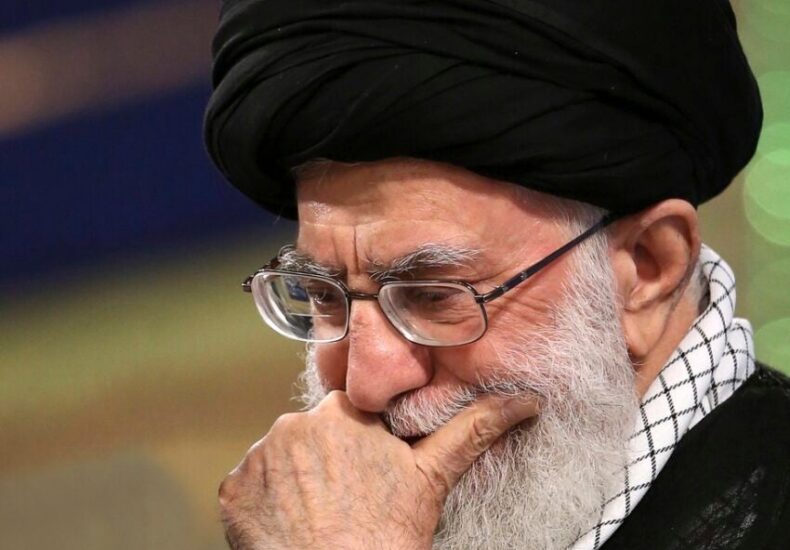
Iran’s supreme leader has been killed during major attack, Trump says
**Major Attack by U.S. and Israel Kills Iranian Supreme Leader Ayatollah Ali Khamenei, Trump Announces**
*DUBAI, United Arab Emirates (AP)* — A major military operation launched by Israel and the United States has resulted in the death of Iranian Supreme Leader Ayatollah Ali Khamenei, U.S. President Donald Trump announced Saturday.
Describing Khamenei as “one of the most evil people in history,” Trump declared the assassination a pivotal moment, offering Iranians their “greatest chance” to reclaim their country. He also warned of ongoing “heavy and pinpoint bombing” operations expected to continue throughout the week and beyond.
The U.S. justified the assault as necessary to disable Iran’s nuclear capabilities, though Iran has not immediately confirmed the death of its supreme leader.
—
### A New Chapter in U.S.-Iran Relations
The attack marks a dramatic escalation in U.S. intervention in Iran and raises concerns about potential retaliatory violence in the Middle East and globally. It showcases a significant military assertion from President Trump, who initially campaigned on an “America First” platform, vowing to avoid “forever wars.”
If confirmed, Khamenei’s death creates a critical leadership vacuum. At 86, Khamenei had ruled as the unchallenged authority in Iran’s clerical theocracy for decades, controlling both the Revolutionary Guard and the country’s major policy decisions. No clear successor has emerged.
—
### Reactions from Iran and the Region
Eyewitnesses in Tehran reported scenes of mixed reaction, with some residents rejoicing in the streets. However, Iran swiftly retaliated with missile and drone strikes against Israeli and U.S. military targets in the region.
Ali Larijani, secretary of Iran’s National Security Council, condemned the attacks, warning that Israel and the U.S. “will regret their actions.” Larijani vowed that Iran’s military and people would deliver an “unforgettable lesson” to what he called “hellish international oppressors.”
—
### Details of the Joint U.S.-Israel Operation
The meticulously planned joint operation took place on Saturday during the Islamic holy month of Ramadan and the Iranian workweek’s start.
About 12 hours into the offensive, U.S. military officials reported no casualties and minimal damage at American bases, despite “hundreds of Iranian missile and drone attacks.”
Targets across Iran included Revolutionary Guard command centers, air defense systems, missile and drone launch sites, and military airfields.
Israel confirmed it had killed the commander of the Iranian Revolutionary Guard Corps, the country’s defense minister, and the secretary of the Iranian Security Council—close aides to Khamenei.
President Trump stated, “Khamenei was unable to avoid our Intelligence and highly sophisticated tracking systems.” He described the strike as “the single greatest chance for the Iranian people to take back their country.”
—
### Civilian Impact and Humanitarian Concerns
Reports emerged that hundreds of civilians were killed or wounded. An Iranian diplomat addressing the United Nations Security Council alleged high civilian casualties.
In southern Iran, at least 115 people died when a girls’ school was struck, with dozens more injured, according to local officials. Iran’s state news agency IRNA also reported fatalities resulting from strikes on sports halls, residential areas, and vicinity near schools.
U.S. Central Command is investigating these reports and assessing the humanitarian impact.
—
### Tensions and Military Responses Escalate
Iran responded by launching missile and drone attacks targeting Israeli territory and U.S. military installations in Bahrain, Kuwait, and Qatar. Israel reported intercepting many incoming missiles, though some caused damage. Emergency services in Israel noted 89 people with light injuries.
Explosions near Tehran’s Intelligence Ministry and air defense activity were reported, while Israel indicated continuing strikes against missile launchers and defense systems across central Iran.
Shrapnel from Iranian missile attacks also hit Dubai, in the United Arab Emirates, killing one person and causing disrupted flights across the Middle East.
Saudi Arabia confirmed it repelled attacks on its capital and eastern regions, and Bahrain reported damage to buildings near the U.S. Navy’s 5th Fleet headquarters.
—
### Political and Global Implications
The strikes have heightened political tensions internationally. Democrats criticized the actions as lacking congressional authorization, though the White House said key Republican and Democratic leaders were briefed beforehand.
Secretary of State Marco Rubio canceled a planned trip to Israel in light of recent developments.
The potential for destabilizing global markets looms, particularly concerning the Strait of Hormuz, through which a third of worldwide oil exports flow. Increased volatility in this vital corridor could disrupt energy supplies globally.
—
### Looking Ahead
President Trump acknowledged the possibility of American casualties, emphasizing the campaign’s goal to “annihilate” the Iranian navy and destroy Tehran’s regional proxies. He pledged immunity to members of the Revolutionary Guard who laid down arms, threatening “certain death” for those who did not.
Iran, while asserting its right to enrich uranium, hopes to avoid full-scale war. International observers note Iran has blocked inspections at key nuclear sites bombed in the strikes, despite claims of halting enrichment since June.
The recent crackdown on nationwide protests in Iran resulted in significant casualties, further complicating the internal political landscape.
—
### Concluding Remarks
This pivotal event marks an unprecedented military escalation in U.S.-Iran relations, with profound consequences for regional stability and global geopolitics. The coming days will likely reveal more about Iran’s response and the broader international reaction to this historic attack.
—
*Reporting contributed by Joe Federman in Jerusalem, Aamer Madhani and Konstantin Toropin in Washington, Sam Mednick in Tel Aviv, Farnoush Amiri in New York, and Associated Press journalists worldwide.*
*This story has been corrected to reflect that IRNA reported 40 people were killed in the school strike, without specifying student casualties.*
https://www.boston.com/news/world-news/2026/02/28/irans-supreme-leader-has-been-killed-during-major-attack-trump-says/
You may also like

延伸阅读
You may be interested
 The New York Times
- Israel Targeted Top Iranian Leaders in Attack’s Opening Strikes 2026 年 2 月 28 日 Abdi Latif Dahir and Aaron Boxerman
- Mapping the U.S.-Led Attacks on Iran 2026 年 2 月 28 日 Lazaro Gamio, Samuel Granados, Josh Holder, Blacki Migliozzi, Pablo Robles, Helmuth Rosales, Elena Shao and Daniel Wood
- No Clear Endgame in the Conflict Between Afghanistan and Pakistan 2026 年 2 月 28 日 Elian Peltier
- Abrupt Change for Warner Bros. Prompts Many Grim Faces 2026 年 2 月 28 日 Brooks Barnes and John Koblin
- Epstein Effort to Finance a Dick Cavett Film Undone by Background Check 2026 年 2 月 28 日 Michaela Towfighi and Julia Jacobs
- War With Iran Is a Mistake 2026 年 2 月 28 日 Nicholas Kristof
- Elite Doctors Served Jeffrey Epstein While Treating His ‘Girls’ 2026 年 2 月 28 日 David A. Fahrenthold, Azeen Ghorayshi and Maggie Astor
- What to Know About the U.S. Attacks on Iran 2026 年 2 月 28 日 Lynsey Chutel
- Lloyd Blankfein on Trump, Epstein and Life After Goldman Sachs 2026 年 2 月 28 日 Andrew Ross Sorkin
- OpenAI Reaches A.I. Agreement With Defense Dept. After Anthropic Clash 2026 年 2 月 28 日 Cade Metz
Leave a Reply