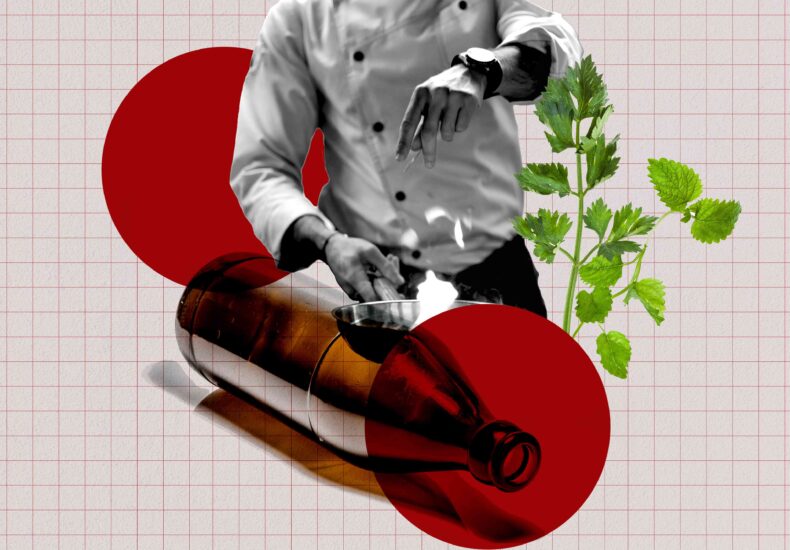
How Getting Sober Changed This Chef’s Relationship with Food
If anyone could make an enemy out of food, it was my mother.
Her revulsion for ingredients was wide-ranging: rare beef, pork of any cut or cook, milk, butter, cream, mayonnaise, runny eggs, and hollandaise. But really, it was salt she hated the most. To my mother, salt was as frivolous in the pantry as a sack of candy: unnecessary junk that did little beyond poison the arteries.
She never said this outright, but I think she blames salt for playing some part in killing her father. After his first heart attack, his doctor told him he needed to lower his sodium intake. He ate saltless meal after saltless meal and rode his bike religiously, but the second heart attack still got him at 59.
Whenever my mother wasn’t on a dinner shift at the restaurant where she worked, she put a home-cooked meal on the table. Lots of baked chicken and fish, salads, steamed veggies. Lots of oregano, balsamic, and olive oil. Lots of time and care. But zero salt.
Besides the lone glass saltshaker she kept for guests—the one with iodized Morton table salt and dry rice grains, tucked away in the darkest depths of the cupboard—you wouldn’t find a grain of salt in the house. You could find a collector’s inventory of Mrs. Dash, though. Mom had them all on deck: Original, Garlic & Herb, Chicken. In our house, they were used in the literal sense: instead of salt.
When I moved to the California coast for college, my mom lost a reason to cook, and I gained a penchant for beer and cocaine. I used to joke that they were my two favorite foods.
After college, I moved to New Orleans, where I was supposed to become a teacher but instead became a cook. I worked in restaurants there for a couple of years before eventually moving to New York City to hone the art of working the line.
I usually shoved down my only meal of the day in the late afternoon during family meal. I developed a preference for grease and salt—foods that soaked up the booze in my gut left over from the night before.
After work, I slugged tallboys of Miller High Life and chain-smoked until I fell into a dreamless paralysis, only to wake up in a groggy sweat and do it all over again. I was railing against the healthy food my mother set in front of me as a kid.
I was living by the advice of Anthony Bourdain: “Your body is not a temple, it’s an amusement park.” I was enjoying the ride, and I was invincible. Until I wasn’t.
At my bottom, I was very overweight. I stood on a roof on the Lower East Side of Manhattan, out of beer and cocaine, watching the sunrise. It was beautiful, but I couldn’t enjoy it through the shame and guilt that was dissolving me into a familiar hangover.
“I either quit living like this,” I thought, “or I kill myself.”
A friend talked me into going to my first AA meeting that day. My partner came with me and put her hand on my back while I sobbed through all the prayers. They were good sobs.
Finally, it made sense. I am an addict. And I needed to change.
When I got sober, something shifted inside of me. I became more intentional with what I put in my body. I relearned to love cooking for myself and for others.
I started making things my mom would make—salads with dark leafy greens and herbs, roast chicken, seared trout. But I did it a little differently.
I massaged my greens with kosher salt and tossed them with cilantro, mint, and basil. I brined my chicken, took the backbone out, and roasted it flat until it turned gold. I kept the skin on my fish, scored it with a razor, and seared it hard until it got crispy.
My mother and I live across the country from one another, but whenever I get the chance, I cook for her.
I make her things she would have never eaten when I was a kid. I watch her face soften when she realizes how much better a floret of broccoli or an artichoke heart can taste with a pinch of kosher salt.
I’ve sent her things to encourage her to cook more for herself, like a nice knife or a cookbook. I’ve told her to buy Diamond Crystal kosher salt, because it’s the cleanest-tasting and least-salty salt; that most vegetables are better roasted; that a sauce can use probiotic yogurt instead of cream to achieve the same richness; and that she shouldn’t feel bad about having a slice of Margherita pizza with good tomatoes and mozzarella every now and again.
But really, I wish I could cook for her more, the way she used to cook for me.
I wish I could stand there, over the counter, and tell her how much I appreciate the way she took care of me, worrying about the little things I put in my body.
I want to tell her that I’m not afraid of dying anymore, but I’m not afraid of living either. That both of us are worth our salt. That salt ain’t so bad when you know the purpose it serves.
https://www.eatingwell.com/chef-sobriety-journey-11877258
You may also like



延伸阅读
You may be interested
 The New York Times
- Kanye West ‘Should Never Have Been Invited,’ Starmer Says After Barring Rapper From UK 2026 年 4 月 7 日 Michael D. Shear
- Newlywed Wife of U.S. Soldier Released From Immigration Detention 2026 年 4 月 7 日 Miriam Jordan
- Protests in Mexico Challenge Move of Frida Kahlo Trove to Spain 2026 年 4 月 7 日 Victoria Burnett and Zachary Small
- What the Iran War Will Do to Your Life and Our Economy 2026 年 4 月 7 日 Bill Saporito and David Stubbs
- Iranians Voice Shock and Defiance in Face of Trump’s Looming Deadline 2026 年 4 月 7 日 Erika Solomon and Sanam Mahoozi
- ICE Agents Shoot Into a Car, Injuring a Suspect in Northern California 2026 年 4 月 7 日 Soumya Karlamangla and Hamed Aleaziz
- Shelly Kittleson, American Journalist Abducted in Iraq, Is Freed 2026 年 4 月 7 日 Falih Hassan, Pranav Baskar and Erika Solomon
- NASA’s Artemis II Astronauts Spread ‘Moon Joy’ to the Public 2026 年 4 月 7 日 Katrina Miller
- Trump Threatens Broad Attacks in Iran. How Is Illegal Conduct in War Defined? 2026 年 4 月 7 日 Thomas Gibbons-Neff
- Gulf Backers Invest $24 Billion in Paramount’s Deal for Warner Bros. 2026 年 4 月 7 日 Lauren Hirsch and Benjamin Mullin
Leave a Reply