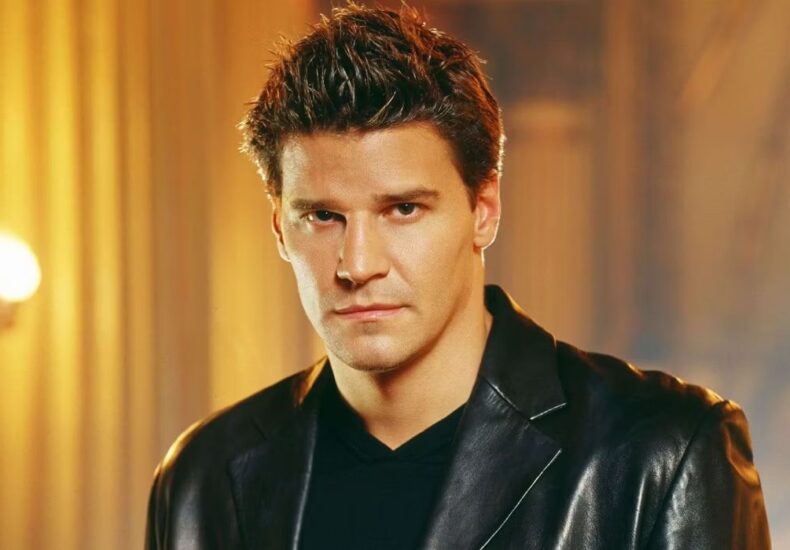
26 Years Ago, ‘Angel’ Completely Redefined What a Supernatural TV Show Could Be
In May 1999, it wasn’t just the Scooby Gang who were graduating high school in *Buffy the Vampire Slayer*. Three of the main cast were moving to a brand-new spin-off, *Angel*, which focused on David Boreanaz’s vampire with a soul as he makes a new death for himself in Los Angeles. Joined by Cordelia Chase (Charisma Carpenter) and Wesley Wyndham Pryce (Alexis Denisof), the newly formed Angel Investigations took the fight to the streets, “helping the helpless.”
Instead of exploring the usual suburban teenage angst, *Angel* examined darker areas of society that would give the Slayer (Sarah Michelle Gellar) “the wiggins!” The show played with the typical monster-of-the-week format, where series like *The X-Files* reset the status quo after every demon encounter. Instead, cases contributed to Angel’s overarching quest for redemption.
His fate was discovered in a prophecy at the interdimensional law firm, Wolfram & Hart, who also became Angel’s primary foil across all five seasons. With redemption as his driving motivation and a team of lawyers sabotaging his every move, the series maintained cumulative tension in which no victory was guaranteed, and no character was safe. That is why it works so well. Every episode carried real and lasting consequences, truly raising the stakes for what supernatural stories could do.
—
### Angel’s Ongoing Quest for Redemption Puts Everyone Around Him in Danger
The high stakes of Angel’s redemption are evident from the very beginning, establishing a world where choosing to do good comes with real risk.
Before Wesley joins the team, Doyle (Glenn Quinn) serves as Angel’s half-demon right-hand man. Across just nine episodes, viewers quickly become endeared to his humor and growing romance with Cordelia. However, in Season 1, Episode 9, “Hero,” Doyle sacrifices himself to save a group of demons, atoning for his past failure to protect his own family from the same attackers. His death is sudden and permanent, setting the tone for the series early on.
These visions drive Angel’s mission and connect the team to the Powers That Be, but they also ensure that stepping into the fight against evil carries a personal cost. From this moment on, Cordelia is no longer safe. Her visions worsen throughout the series, causing severe physical pain as she experiences injuries that mirror those of the victims she sees. Remaining part of Angel’s fight demands constant sacrifice, and she chooses to become half-demon to sustain the visions.
Cordelia is then sent to a higher plane, becomes possessed, and ultimately dies in Season 5 after falling into a coma.
Angel’s pursuit of redemption consistently inspires those around him, but it also places them directly in danger. Both Doyle and Cordelia choose to support Angel’s mission, knowing they will have to make sacrifices. Doyle seizes his own chance at redemption despite understanding it will lead to his death, deciding that correcting his past and doing the right thing matters more.
*Angel* proves that supernatural stories work best when victory isn’t guaranteed, and its refusal to soften the consequences keeps the series emotionally compelling, even when it leaves the audience heartbroken.
—
### Can Angel Investigations Ever Win With Wolfram & Hart on Their Case?
If Angel is fighting the good fight across five seasons, then the side of evil is embodied by Wolfram & Hart—the interdimensional law firm run by humans who are as ruthless as any demon. From the very beginning, the firm represented a form of systemic evil.
Its power ensures that immorality continues across dimensions, meaning that any victory Angel Investigations achieves is temporary at best. Even when an individual operative or branch is defeated, the institution itself remains intact. Wolfram & Hart cannot be beaten in a single moment, only resisted, and this guarantees that no win is ever final.
Introduced in Season 1, Episode 1, “City Of,” Wolfram & Hart are immediately shown defending corrupt clients and excusing illegal acts. Angel rescues Cordelia from a stalker vampire, follows him back to the firm’s offices, and kicks him out of the skyscraper window, burning him to a crisp in the sunlight.
He goes straight to the top of Wolfram & Hart’s most-wanted list and becomes the personal project of lawyers Lindsey McDonald (Christian Kane) and Lilah Morgan (Stephanie Romanov), who begin interfering in his personal and professional life. From this point on, Wolfram & Hart ensure that Angel’s pursuit of redemption is constantly disrupted.
Their manipulation escalates in Season 2, Episode 3, “First Impressions,” when Wolfram & Hart resurrect Angel’s former girlfriend, Darla (Julie Benz), from hell as a human. Rather than attacking directly, they use psychological warfare, having her invade Angel’s mind and attempt to trigger a “moment of pure happiness” that would bring back the vampire, Angelus.
This pattern continues in Season 3, Episode 7, “Offspring,” when Darla returns pregnant with Angel’s child, Connor (Vincent Kartheiser). Wesley’s discovery of a false prophecy leads him to kidnap the baby, sending Connor to a hell dimension. Under Wolfram & Hart’s influence, everyone involved is pulled further down a destructive path.
The constant presence of Wolfram & Hart in *Angel* ensures that the fight between good and evil is never clean or contained, and the score can never be settled, only prolonged. As the characters descend into moral compromise, the series becomes both unsettling and deeply engaging.
Refusing easy wins ensures that neither the characters nor the audience is ever allowed to feel safe.
—
### Angel Season 5 Epitomizes “If You Can’t Beat Them, Join Them”
*Angel* Season 5 is the crescendo of the series’ relationship with Wolfram & Hart, and it is here that it fully rejects the idea of victory altogether.
Rather than defeating the firm, Angel is drawn deeper into it. When Connor returns from the hell dimension, his relationship with his father is destructive and dangerous, leaving Angel consumed by guilt. Wolfram & Hart exploit this weakness and offer him control of the Los Angeles branch of the firm.
Crucially, the deal involves rewriting Connor’s memories, giving him a normal life and erasing Angel as his father. Angel’s greatest emotional weakness is removed, but only by leaving him indebted to Wolfram & Hart.
The Angel Investigations team all accept new positions at the firm, claiming that Wolfram & Hart’s resources will allow them to do more good. In reality, they are motivated by temptation, power, and convenience, while also becoming buried under the firm’s bureaucracy.
By separating the core group into different departments, the firm isolates them from one another and pulls them further away from their original mission.
With Cordelia in a coma, there is no longer a clear link to the Powers That Be, leaving Angel and the others without clear moral direction. This makes the team vulnerable to their own insecurities.
Charles Gunn (J. August Richards), long defined as the muscle of the group, undergoes a psychological procedure that implants legal knowledge into his brain. Fred (Amy Acker), Head of the Science Division, dies after opening a sarcophagus sent to the firm and allowed through customs by Gunn’s signature.
The artifact releases the ancient demon, Illyria, which possesses her. Despite the firm’s vast resources, there is no cure. The team is distracted by other missions and the responsibilities of their new positions, so Fred dies in Wesley’s arms before Illyria takes over her body for the rest of the season.
Fred’s death is the clearest example of why *Angel* refuses the safety net common in other supernatural series. It’s a devastating emotional moment that cements the show’s high stakes, and as such, the losses mean more and stay with you. There is not always a triumphant rescue, and the tragic deaths of the main characters permanently alter the series.
Angel has been Wolfram & Hart’s focus all along, and by choosing to stay with him, his friends ultimately secure their own demise.
Across its five seasons, *Angel* consistently refuses the comfort of guaranteed victory. By stepping inside Wolfram & Hart rather than defeating them, Angel accepts that there are no clean wins left, just endurance.
It is this willingness to double down on consequences that explains why *Angel* still hits hard 26 years after its premiere.
https://collider.com/angel-david-boreanaz-supernatural-show-format-change/
You may also like

参考资料
You may be interested
 The New York Times
- Across Asia, Trump’s War on Iran Is Dangerous for Everyone 2026 年 3 月 30 日 Meena Kandasamy
- Gao Zhen, a Chinese Artist Accused of Mocking Mao, Goes on Trial 2026 年 3 月 30 日 Lily Kuo
- He Led Congo for 18 Years. Now, Joseph Kabila Is a Hunted Man. 2026 年 3 月 30 日 Ruth Maclean
- They’ve Been Accused of Running a ‘Covert’ Operation in Greenland. It’s No Secret. 2026 年 3 月 30 日 Jeffrey Gettleman and Maya Tekeli
- New U.S. Missile Hit Iranian Sports Hall and School, Analysis Shows 2026 年 3 月 30 日 Christiaan Triebert and John Ismay
- U.S. Allows Russian Oil Tanker to Reach Cuba, Despite Blockade 2026 年 3 月 30 日 Jack Nicas and Eric Schmitt
- Mamdani and Curtis Sliwa Performed a Skit. N.Y. Republicans Are Livid. 2026 年 3 月 29 日 Dana Rubinstein and Sally Goldenberg
- Bernie Sanders, in the Bronx, Presses Kathy Hochul to Tax the Rich 2026 年 3 月 29 日 Miles G. Cohen
- Nicholas Haysom, Apartheid Foe Who Became a U.N. Peacemaker, Dies at 73 2026 年 3 月 29 日 Adam Nossiter
- Politico Names Jonathan Greenberger as New Editor 2026 年 3 月 29 日 Katie Robertson
Leave a Reply