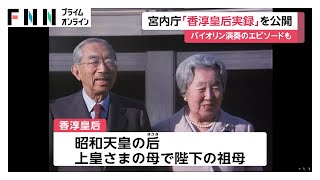
‘The True Story of Empress Kojun’ Released
The record, which took 17 years to complete, sheds light on the wartime activities of the Imperial Family, revealing that the Empress herself helped manufacture components for military equipment.
Empress Kojun, who lived through Japan’s turbulent modern era, passed away in 2000 at the age of 97. The chronicle provides new insight into the intersection between the Imperial Household and the war.
According to the record, Empress Kojun presented artificial eyes and limbs to wounded soldiers. When school evacuations were implemented, she sent about 410,000 biscuits to children across Japan. At that time, her son—now Emperor Emeritus—had been evacuated to Tochigi Prefecture. The biscuits were distributed on December 23, his birthday.
Between 1944 and 1945, as the war intensified, the Empress spent time making grids—components used in vacuum tubes for radio detection devices that could locate enemy submarines. Such parts were typically produced by female students mobilized nationwide to compensate for labor shortages. The record reveals that Empress Kojun also participated in this work within an air-raid shelter at the Imperial Palace known as Gobunko.
For the first time, the record also describes her actions on the day Japan announced its surrender. At 11:55 a.m., Her Majesty turned on the radio in the Gobunko and listened quietly until the end of the Imperial broadcast announcing the end of the Greater East Asia War. Afterwards, she greeted His Majesty and inquired after his well-being, it notes.
The newly released chronicle offers a valuable primary source for understanding Japan’s modern and wartime history through the life of the Showa Empress.
https://newsonjapan.com/article/147222.php
You may also like



参考资料
You may be interested
 The New York Times
- ‘Stand Up’: With One Maneuver, Trump Tries to Box In Democrats 2026 年 2 月 25 日 Shawn McCreesh
- Jimmy Kimmel Goes Live After a Super Long State of the Union 2026 年 2 月 25 日 Trish Bendix
- Abigail Spanberger, in Democratic Response, Asks if Trump Is Working for Americans 2026 年 2 月 25 日 Reid J. Epstein
- No, the Dollar Is Not Dying 2026 年 2 月 25 日 Eswar Prasad
- Leader of Columbia Brain Institute Quits Over Friendship With Epstein 2026 年 2 月 25 日 Sharon Otterman
- Futsal Phenom in Afghanistan Is a Hero the Taliban Didn’t Expect 2026 年 2 月 25 日 Elian Peltier, Yaqoob Akbary and Tomás Munita
- In Windsor, Some See Family Drama in the Andrew Accusations 2026 年 2 月 25 日 Megan Specia and Stephen Castle
- Abu Dhabi’s State Oil Company Looks Beyond Oil 2026 年 2 月 25 日 Stanley Reed and Natalie Naccache
- Pentagon Gives Anthropic an Ultimatum Over the Company’s A.I. Model 2026 年 2 月 25 日 Julian E. Barnes and Sheera Frenkel
- Court Rules Against Justice Dept. Search of Reporter’s Computers 2026 年 2 月 25 日 Erik Wemple
Leave a Reply