SpaceX launches second satellite to monitor sea level changes
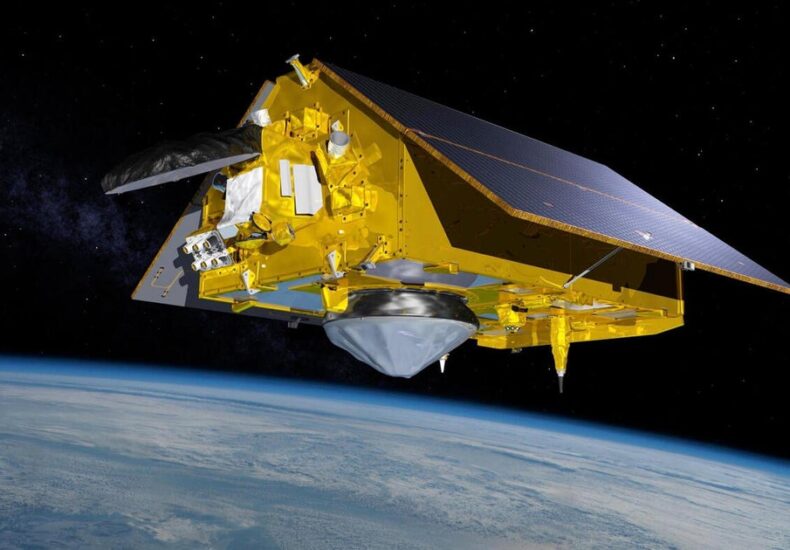
SpaceX launched a joint NASA-European environmental research satellite early Monday, marking the second mission in an ongoing billion-dollar project to measure long-term changes in sea level—a key indicator of climate change.
The first satellite, known as Sentinel-6 and named in honor of NASA climate researcher Michael Freilich, was launched in November 2020. The latest spacecraft, Sentinel-6B, lifted off from California atop a Falcon 9 rocket at 12:21 a.m. EST.
Both satellites are equipped with sophisticated cloud-penetrating radar. By timing how long it takes radar beams to bounce back from the ocean 830 miles below, the Sentinel-6 satellites can track sea levels with an accuracy of about one inch. They also measure wave height and wind speeds.
This project builds on earlier missions dating back to the early 1990s that have provided an uninterrupted stream of sea level data. That data indicates sea levels are slowly but surely rising, widely interpreted as evidence of global warming caused largely by human industrial activity.
However, in line with recent policies of the Trump administration aimed at scaling back climate research and the interpretation of such data, NASA did not directly refer to “climate change” or “global warming” during the Sentinel-6B pre-launch briefing on Saturday.
For comparison, the press kit released by NASA for the first Sentinel-6 mission in 2020 stated that the satellite would “provide information that will help researchers understand how climate change is reshaping Earth’s coastlines and how fast this is happening.”
In the press kit for the Sentinel-6B mission launched Monday, NASA’s first “need to know” item simply said that “Sentinel-6B will contribute to a multi-decade dataset that is key to helping improve public safety, city planning and protecting commercial and defense interests.”
Karen St. Germain, director of NASA’s Earth Science Division, did not directly mention climate change during Saturday’s briefing. Instead, she focused on the practical importance of monitoring sea levels.
“Sentinel-6B is the latest in a line of missions stretching over three decades, keeping an uninterrupted watch over our planet’s sea surface height, finding patterns and advancing our understanding of planet Earth,” she said.
She highlighted that the data provided by the Sentinel-6 satellites “underpins navigation, search and rescue and industries like commercial fishing and shipping.” According to St. Germain, these measurements form the basis for U.S. flood predictions for coastal infrastructure, real estate, energy storage sites, and other assets along the shoreline.
The data will also help scientists “understand and predict coastal erosion and salt water encroachment into inland supplies of water that are used for agriculture, irrigation as well as municipal drinking water,” she added.
Regardless of the political interpretation, the launch of Sentinel-6B went off without a hitch. After blasting off from launch complex 4E at the Vandenberg Space Force Base, the Falcon 9 rocket’s first stage powered the vehicle through the dense lower atmosphere, separated, and then guided itself back to a landing pad at the California launch site.
The upper stage executed two firings of its single engine before releasing the 2,600-pound Sentinel-6B into an 830-mile-high orbit tilted 66 degrees to the equator—the same orbit used by Sentinel-6A and earlier sea level-monitoring satellites.
Taking 112 minutes to complete one orbit, the solar-powered satellite will fly over locations between 66 degrees north and south latitude, covering 90 percent of the world’s oceans.
Along with measuring sea levels, Sentinel-6B will also monitor temperature and humidity in the lower atmosphere as well as the higher-altitude stratosphere. It carries an instrument designed to measure atmospheric effects on signals broadcast by navigation satellites.
However, the primary mission remains monitoring Earth’s changing sea levels.
“The dynamic balance that persisted before the industrial revolution has been upset by the almost instantaneous combustion of huge reserves of carbon as our society has developed,” Craig Donlon, a European Space Agency project scientist, said before the first Sentinel-6 launch in 2020.
“We see evidence of this dramatic change in many different measurements… but they all point in the same direction: the Earth is warming. And the greatest indicator of this Earth system imbalance is sea level rise.”
The Sentinel-6 satellites are the result of a collaboration between NASA, the European Space Agency, the European Organization for the Exploitation of Meteorological Satellites (EUMETSAT), and the National Oceanic and Atmospheric Administration (NOAA).
Karen St. Germain noted that NASA’s share of the cost for both Sentinel-6 satellites came to about $500 million, with European partners contributing a similar amount.
https://www.cbsnews.com/news/spacex-launches-follow-on-international-satellite-to-monitor-sea-level-changes/
You may also like



更多推荐
You may be interested
 The New York Times
- Hormones Don’t Need to Make You Live Longer to Be Worth It 2026 年 4 月 5 日 Gillian Goddard
- Easter Reminds Us That Resurrection Is Everywhere 2026 年 4 月 5 日 P.G. Sittenfeld
- China Built the World’s Drone Industry. Now It’s Locking Down the Skies. 2026 年 4 月 5 日 Joy Dong
- Hollywood Writers Union and Studios Reach Contract Deal 2026 年 4 月 5 日 Brooks Barnes
- Where Are NASA’s Artemis II Astronauts Now? Closer to the Moon Than Earth. 2026 年 4 月 5 日 Katrina Miller
- Judge Pauses Trump Demand for Student Race Data in 17 States 2026 年 4 月 5 日 Orlando Mayorquín
- Dozens Killed in Haiti Massacre as International Force Trickles In 2026 年 4 月 4 日 André Paultre and Frances Robles
- ‘Hacks’ Has the Last Laugh 2026 年 4 月 4 日 Chantal Anderson and Alexis Soloski
- Some Voters Say Congress Is Too Old. These Black Democrats Aren’t Leaving. 2026 年 4 月 4 日 Robert Jimison
- For Many Patients Leaving the I.C.U., the Struggle Has Only Just Begun 2026 年 4 月 4 日 Paula Span
Leave a Reply