America’s untapped rare earth source: its trash
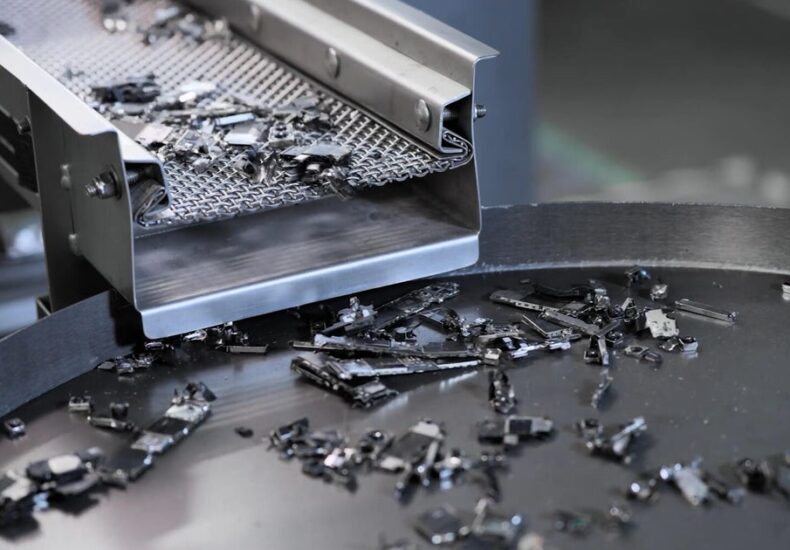
In the race to secure the critical mineral supply chain, the U. S. government has sought to ramp up production of rare earths and rare earth magnets. Now, experts say the key to securing these supplies may not lie simply in opening new mines, but also in reusing what has already been extracted. Rare earths, a group of 17 metallic elements on the periodic table, are essential for many modern technologies, from smart phones and laptops to wind turbines. Their unique properties enable super-strong magnets, amplify fiberoptics and lasers, and help speed up chemical reactions. According to the military, one F-35 fighter jet contains about a hundred pounds of rare earths, incorporated into its various parts. In recent decades, China has built up its rare earths industry and cornered the market on these materials critical not only to American manufacturing, but also to the defense industry. Contrary to what their name suggests, rare earths are not actually scarce in nature. What makes them rare is finding deposits concentrated enough to make mining and processing worthwhile. But according to Julie Klinger, a professor at the University of Wisconsin-Madison, there may be another way. “Less than 1% of the rare earths that we consume are recycled,” Klinger said. “That means we’ve been accumulating rare earths in our waste for decades.” A hidden resource in plain sight Rare earth elements are embedded in countless everyday devices. “There’s not a day that goes by where you don’t interact with rare earth magnetics,” said Matt Sloustcher of MP Materials, which operates the only active rare earth mine in the United States at Mountain Pass, California. From the vibration of a smartphone to the acceleration of electric vehicles, rare earth magnets make the modern world move. Yet once products reach the end of their life, most of the valuable rare earth elements inside of them are lost. Every year, rare earth elements are thrown away in items like outdated electronics, retired airplanes, and decommissioned ships, according to Klinger. Even more of these elements remain buried in thousands of mining waste sites. Why recycling is not straightforward The idea of recycling rare earths is straightforward, but the execution is not. Devices often contain only tiny amounts, meaning large volumes of material must be processed to recover meaningful quantities. Extracting them can also be technically complex. Still, Klinger argues recycling is more environmentally friendly than opening new mines. “You know what’s in there,” Klinger said of recycling. “You know exactly what to expect. And therefore, you also know exactly what environmental protections you need to put in place.” Now, efforts to scale up rare earth recycling are beginning to take shape. MP Materials CEO James Litinsky laid out the challenge as economics: recycling only works at large scale and requires proximity to significant infrastructure. To address that, Apple has partnered with MP Materials as part of a $500 million commitment to use U. S.-made rare earth magnets. The collaboration aims to create a recycling system at MP Materials’ Mountain Pass refinery, where MP Materials will recycle end-of-life and other magnet materials to make separated oxides. They will then send those oxides to their factory in Texas to make into magnets for Apple to use in future products. Apple has also developed its own robot called Daisy that disassembles iPhones to recover materials that traditional recycling often misses. Those recovered rare earths can then be processed and turned into magnets for new devices, creating what industry leaders call a “closed loop” supply chain. Toward a circular economy For Klinger, this approach represents more than just a technical solution. It’s a potential paradigm shift. “I think that we don’t need to dig new holes in the ground to get the material that we need because it’s all around us, currently misrecognized as waste,” Klinger said. If scaled successfully, rare earth recycling could strengthen supply chain security and lessen dependence on foreign sources, all while transforming how critical materials are sourced in the modern economy. As Klinger put it: “It literally closes the loop.” The video above was produced by Brit McCandless Farmer, Graham Messick, and Alex Ortiz. It was edited by Scott Rosann. Photos and Video courtesy of Theodore Grey and Getty Images.
https://www.cbsnews.com/news/how-recycling-could-help-power-americas-rare-earth-future-60-minutes/
You may also like



参考资料
You may be interested
 The New York Times
- France Chose Thousands of New Mayors on Sunday. Here’s Why It Matters. 2026 年 3 月 22 日 Mark Landler
- Israel Orders Military to Intensify Demolitions in Southern Lebanon 2026 年 3 月 22 日 Aaron Boxerman
- Israel Thought It Could Spur Rebellion Inside Iran. That Hasn’t Happened. 2026 年 3 月 22 日 Mark Mazzetti, Julian E. Barnes, Edward Wong and Ronen Bergman
- The Billionaire Funding France’s Far Right 2026 年 3 月 22 日 Catherine Porter
- ICE to Help TSA at Airports Amid Partial Shutdown, Trump’s Border Czar Says 2026 年 3 月 22 日 Erica L. Green and Gabe Castro-Root
- Not All Malls Are Struggling 2026 年 3 月 22 日 Ian Frisch
- Italy’s Leader Wants to Change the Constitution. Italians Don’t Get It. 2026 年 3 月 22 日 Motoko Rich and Josephine de La Bruyère
- The Supreme Court Could Make it Harder to Vote by Mail in the Midterms 2026 年 3 月 22 日 Nick Corasaniti
- Gas Prices Have Risen More Than 30% in Some States in Weeks Since Iran War Began 2026 年 3 月 22 日 Chris Hippensteel and Steven Rich
- They Want to Stop Paying Taxes as a Protest. There Are Consequences. 2026 年 3 月 22 日 Tara Siegel Bernard
Leave a Reply