U.S. searches for answers to Iran’s arsenal of cheap drones
They call it asymmetric warfare: our highly sophisticated interceptor missiles—Patriots, THAADs—against Iran’s low-tech drones, made of materials you can largely get at your corner hobby store.
While attacks by Iranian drones were down this past week, the amount of damage they have caused has come as a jolt. An Iranian drone attack resulted in the first American casualties of the war when it killed six soldiers in Kuwait. These drones are a drain on U.S. weapons stockpiles and pose a significant threat to the Strait of Hormuz.
In the race to develop a counter weapon, some contenders look like science fiction. Lasers that focus on zapping drones out of the sky are emerging as a promising solution.
—
### Iran’s Drone Arsenal
This Iranian propaganda footage shows its arsenal of drones menacing the Gulf states: blasting apartment buildings, airports, and oil refineries. The Shahed drones are getting faster and stronger; they can move in swarms, and there are swarms of them.
Perhaps their greatest advantage is how cheap they are—often made of flimsy plastics. One costs as low as $20,000. To shoot them down, the U.S. is using anti-missile interceptors that cost millions.
—
### The Laser Solution
A possible solution? Lasers. Wahid Nawabi, CEO of American defense contractor AeroVironment (AV), which makes lasers, explains how this technology can solve the money disparity.
> “A Patriot missile battery costs about $1 billion to procure one system. Each missile costs about $4 million a shot. Compare that to a laser: the cost per shot goes from $4 million to less than $5 a shot. In most cases about $3 a shot.”
The price difference of firing a missile versus a laser is like buying a mansion versus a cup of coffee.
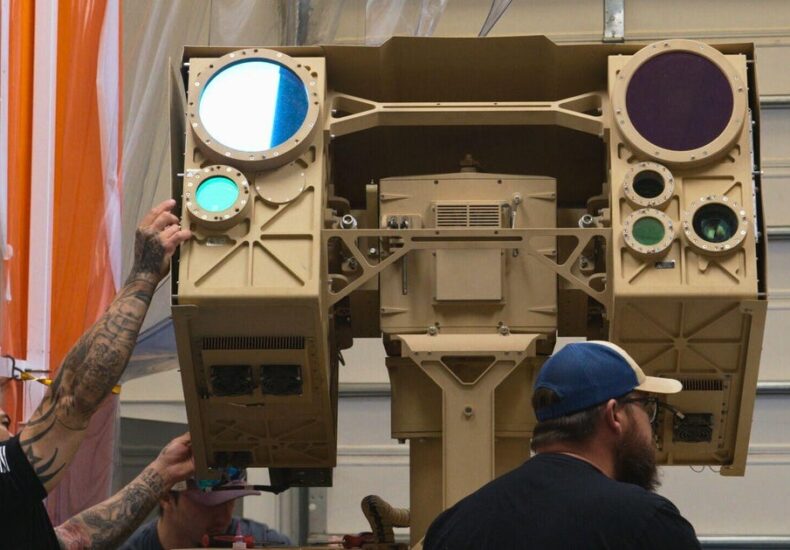
We visited AV in Albuquerque, where their laser system called Locust is built. The top portion, resembling Wall-E, is the beam director—the deadly ray blasts out through one of the “eyes.” The base contains batteries as a power source and a cooling system. Each unit costs roughly $8 million and can be stationary or installed in the back of a truck.
Lesley Stahl asked if Locust has ever been deployed in battle.
> Wahid Nawabi: “Absolutely, yes. Multiple battles in different theaters around the world, including against Shaheds.”
When asked if it has been deployed in the Middle East, Nawabi confirmed it, though he could not disclose specific locations. However, it is not being used in the current war.
—
### Preparedness and Challenges
The prevalence of drones raises the question: why didn’t the U.S. have a cost-effective solution ready?
Mara Karlin, who worked at the Pentagon under both Democratic and Republican administrations and served as assistant secretary of defense for strategy, plans, and capabilities, answered:
> “They went into this war prepared for certain threats, like missiles. They did not go into this war prepared for other threats like drones hitting soft targets.”
When asked if Iran is doing anything surprising, Karlin said:
> “Not really. If anyone were to war game this, you’d know Iran would use cheap, hard-to-counter capabilities like drones in as many spots as possible.”
Regarding whether there is anything in the U.S. arsenal to confront drones:
> “I can’t tell you there is one magic solution. That’s the history of warfare—you find multiple ways to counter different challenges, and then your enemy catches up or counters your counter.”
—
### Laser Competitors and Global Context
While AV is not a household name, it leads in developing drones and lasers. However, their lasers face stiff competition from giants like Lockheed Martin and Raytheon.
Countries around the world are also exploring lasers to combat drones: Israel has Iron Beam, part of the Iron Dome; Ukraine has a system; and China recently revealed its lasers during a large military parade.
—
### How Locust Works
John Garrity, who leads the Locust program, demonstrated how the system operates.
First, Locust’s radars detect enemy drones up to seven miles away as they move toward the target. Then, an operator—using an ordinary X-Box controller—locks onto the drone.
> “From that point on, the laser tracks the drone using AI. I don’t have to touch anything; it follows the drone wherever it goes,” Garrity explains.
As the drone reaches 2-3 miles from the system, the laser focuses its beam to destroy it.
> “Imagine taking a beam of light or a flashlight and pushing that several miles away. It creates enough heat to melt through the plastic or whatever material the drones are made of.”
Garrity demonstrated the system by firing the laser at a drone inside a hangar, showing flames erupting as the drone was destroyed.
> “The benefit of a laser system is you can keep lasing at that target until it goes down.”
When asked if it can shoot down 100 drones at the same time, Garrity said:
> “Because it takes one second or less to kill some of these drones, depending on range, you can quickly go through and complete your mission.”
Regarding whether the system is strong enough to shoot down the Shahed drones Iran is sending, Garrity affirmed:
> “We’ve had great success with those types of drones. Locust is directly intended to get after that Shahed fight.”
—
### Limitations and Considerations
Laser technology remains relatively young and experimental. Ongoing military tests have raised concerns regarding performance, accuracy, battery weight, energy requirements, and effectiveness in certain weather conditions.
Lesley Stahl noted:
> “There’s trouble if it rains, is humid, sandy like in the desert, foggy, or dusty.”
Garrity responded:
> “Traditionally, drones don’t fly in the rain. Our systems have been deployed and remained active in various weather conditions without interruption.”
Mara Karlin weighed in on laser technology’s role in the U.S. arsenal:
> “Lasers are an element of the effort with some investment—though surely not enough. But even for lasers, you need to know where the target is coming from and be able to make the physics work.”
She added:
> “They are very valuable now, but I don’t know if that will be the case six months from now. Warfare evolves.”
—
### Current Use and Future Prospects
As the war enters its third week, laser weapons are maturing just as less powerful and less expensive military hardware is increasingly needed.
When asked if the U.S. military is procuring Locust, Nawabi confirmed:
> “Yes, just this fall, the U.S. Army requested about $100 million worth of Locust laser directed energy systems.”
Interestingly, Locust lasers have been in use since last month—not in the war against Iran, but in the war on drugs at home. The Army is shooting down drones operated by cartels along the Mexican border.
Lesley Stahl asked:
> “Drug smugglers are sending drugs in by drone?”
Nawabi replied:
> “Not just one direction.”
The Army reportedly cooperates with Customs and Border Patrol in these operations.
—
### FAA Concerns and Safety
The FAA once shut down the airspace over El Paso, raising concerns that these laser systems might interfere with or harm commercial airplanes.
Wahid Nawabi dismissed this:
> “That’s not true. The FAA recently conducted tests to ensure and demonstrate our systems cannot and will not harm commercial airliners.”
When asked if aiming the beam at a commercial plane could disable it, Nawabi said:
> “The system is designed not to make mistakes like that.”
—
### Export and Production Challenges
To sell these lasers to Gulf states, Pentagon and State Department approval is required due to national security concerns.
When Stahl asked if the company could supply, for example, 500 systems to Bahrain immediately, Nawabi said:
> “Not tomorrow. So far, we’re only authorized to provide these to the U.S. military. I cannot risk building $1 billion worth of the systems without a guaranteed contract.”
Even if approved, scaling up production would take months.
—
### Conclusion
Laser weapons like Locust represent a promising, cost-effective counter to cheap, ubiquitous drones in modern warfare. Despite operational demonstrations and increasing demand, challenges remain in production scale, export restrictions, and evolving threats. As the battlefield changes, so too must the tools to defend it.
—
*Produced by Shachar Bar-On and Jinsol Jung. Broadcast associate: Aria Een. Edited by Matthew Lev. Assistant editor: Aisha Crespo.*
https://www.cbsnews.com/news/irans-drones-a-drain-on-us-weapons-stockpile-could-lasers-help-fend-them-off-60-minutes-transcript/
You may also like



相关资源
You may be interested
 The New York Times
- Entering War’s Third Week, Trump Faces Stark Choices 2026 年 3 月 15 日 David E. Sanger, Eric Schmitt, Tyler Pager, Ronen Bergman and Julian E. Barnes
- The $500 Million Mystery Will, Signed by Ghosts 2026 年 3 月 15 日 David Segal
- Powerful Winter Storm Disrupts Travel and Knocks Out Power in the Upper Midwest 2026 年 3 月 15 日 Johnny Diaz
- Israel Says Michigan Synagogue Attacker’s Brother Was a Hezbollah Commander 2026 年 3 月 15 日 Isabel Kershner and Natan Odenheimer
- Markwayne Mullin, Trump’s Homeland Security Pick, Got Wealthier Stock Trading in Congress 2026 年 3 月 15 日 Christopher Flavelle, Madeleine Ngo and Georgia Gee
- ‘Nobody Owns Us’: How Plans for a Google Data Center Divided an Oklahoma Town 2026 年 3 月 15 日 Adeel Hassan
- A Refugee Died After Border Agents Left Him at a Cafe. Fear Followed. 2026 年 3 月 15 日 Mark Sommer
- Timothée Chalamet Was Supposed to Be a New Kind of Leading Man 2026 年 3 月 15 日 Naveen Kumar
- State Department Cuts Price of Renouncing U.S. Citizenship to $450 2026 年 3 月 15 日 Ali Watkins
- Why Minnesota Matters More Than Iran for America’s Future 2026 年 3 月 15 日 Thomas L. Friedman
Leave a Reply